
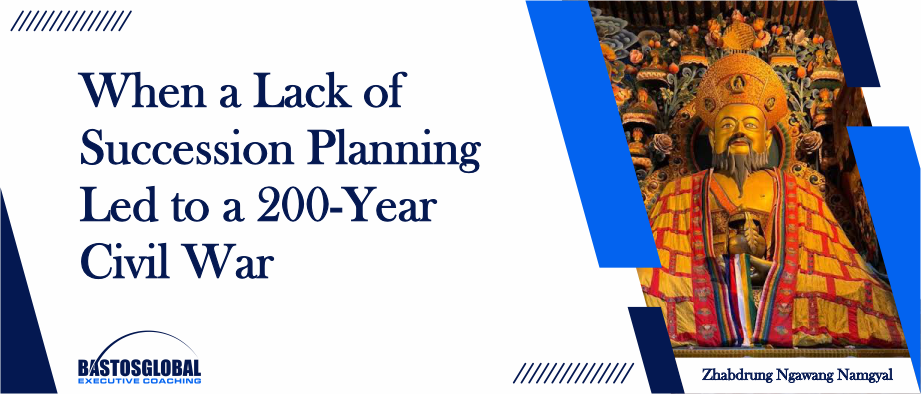
During a recent trip to Bhutan, I visited the magnificent Punakha Dzong, one of the country’s most important historical landmarks. Among its many sacred relics lies the embalmed body of Zhabdrung Ngawang Namgyal, the man credited with unifying Bhutan in the 17th century and creating the foundations of the modern nation.
What fascinated me most was not his life, but what happened after his death.
Or rather, what didn’t happen.
When Zhabdrung died in 1651, his death was deliberately concealed for 54 years.
The reason seemed sensible at the time. Bhutan had only recently been unified from a collection of competing valleys, local rulers, and religious factions. Zhabdrung was not only the political leader of the country but also its highest spiritual authority. Those around him feared that news of his death would trigger instability, power struggles, foreign intervention, or even civil war.
To preserve order, government officials continued issuing decrees in his name. Information about his condition was tightly controlled, and the public was told that he was on an extended religious retreat. The appearance of continuity was maintained, allowing the state to function while leaders tried to navigate the succession challenge.
On the surface, the strategy worked.
For more than five decades, Bhutan remained stable.
But a critical problem remained unresolved: nobody had established a clear and accepted transition of power.
The succession issue wasn’t solved. It was simply postponed.
When the truth eventually emerged in 1705, Bhutan entered a prolonged period of political conflict and fragmentation. Regional leaders and competing factions fought for influence and control. The country experienced more than two centuries of internal power struggles before finally reunifying under Ugyen Wangchuck, Bhutan’s first Dragon King, in 1907.
It is a remarkable story. It is also a powerful lesson in leadership.

Punakha Dzong.
Delaying a Problem Is Not the Same as Solving It
Many organizations make the same mistake today.
When performance is strong and the current leader is successful, succession planning often falls to the bottom of the priority list. There always seems to be something more urgent to focus on: growth targets, operational challenges, customer demands, acquisitions, market pressures, or the next quarterly results.
As a result, leadership continuity becomes tomorrow’s problem.
Until tomorrow arrives unexpectedly.
The reality is that every leader eventually leaves. Some retire. Some move on to new opportunities. Others leave suddenly because of health issues, personal circumstances, or factors beyond anyone’s control.
Yet many organizations remain surprisingly unprepared for this inevitability.
The Leadership Legacy Most Executives Forget
In my coaching work with CEOs and senior executives, I often observe a similar pattern.
Most leaders care deeply about their legacy. They want to be remembered for transforming the business, building a great culture, driving growth, or navigating significant change.
What many overlook is that their true legacy is determined not by what happens while they are in the role, but by what happens after they leave.
A company that thrives after a leadership transition is evidence of sustainable leadership.
A company that struggles, loses direction, or enters internal battles over succession reveals that leadership capability was concentrated in one individual rather than embedded in the organization.
In other words, success was personalized instead of institutionalized.
The strongest leaders are not the ones who make themselves indispensable.
They are the ones who ensure the organization can succeed without them.

Succession planning helps organizations thrive beyond one leader.
Succession Planning Is a Strategic Imperative
Succession planning is often viewed as an HR exercise. It is not.
It is one of the most important strategic responsibilities of any board, CEO, and executive team.
Effective succession planning means identifying future leaders early, developing them intentionally, and giving them opportunities to gain the experience required for larger responsibilities.
It means ensuring that critical knowledge, relationships, and decision-making capability are shared rather than concentrated in a single individual.
Most importantly, it means accepting that leadership is temporary, while the organization should endure.
The goal is not to create dependence on a leader.
The goal is to create leadership capacity throughout the organization.

Strong leaders prepare the organization for the next transition.
A Simple Question for Every Leader
The story of Zhabdrung Ngawang Namgyal highlights a timeless truth: stability built around one person is fragile.
The leaders who concealed his death believed they were protecting the nation. Instead, they delayed an essential transition and increased the long-term consequences of failing to address it.
Today’s organizations are unlikely to face a 200-year civil war because of poor succession planning.
But they can absolutely destroy long-term value, strategic momentum, and organizational culture when leadership transitions are neglected.
That is why I regularly ask CEOs and senior executives a simple question:
Is your organization prepared to let you go?
The answer may be the clearest measure of your leadership legacy.

BastosGlobal Executive Coaching
Leadership perspectives focused on self-awareness, behavior, performance and practical development for executives and senior leaders.